Formulation & Specification
Ashwagandha Gummies: How to Compare Root Extracts
Buyer Guide · 8 min read · Published 2026-10-11 · Updated 2026-10-15
Two ashwagandha gummies can display very different milligram numbers without containing very different amounts of extract. The comparison starts with what is actually added to each serving: the plant part, extract preparation, extract weight and measured constituents. A root-equivalent figure describes a different quantity and cannot replace those details.
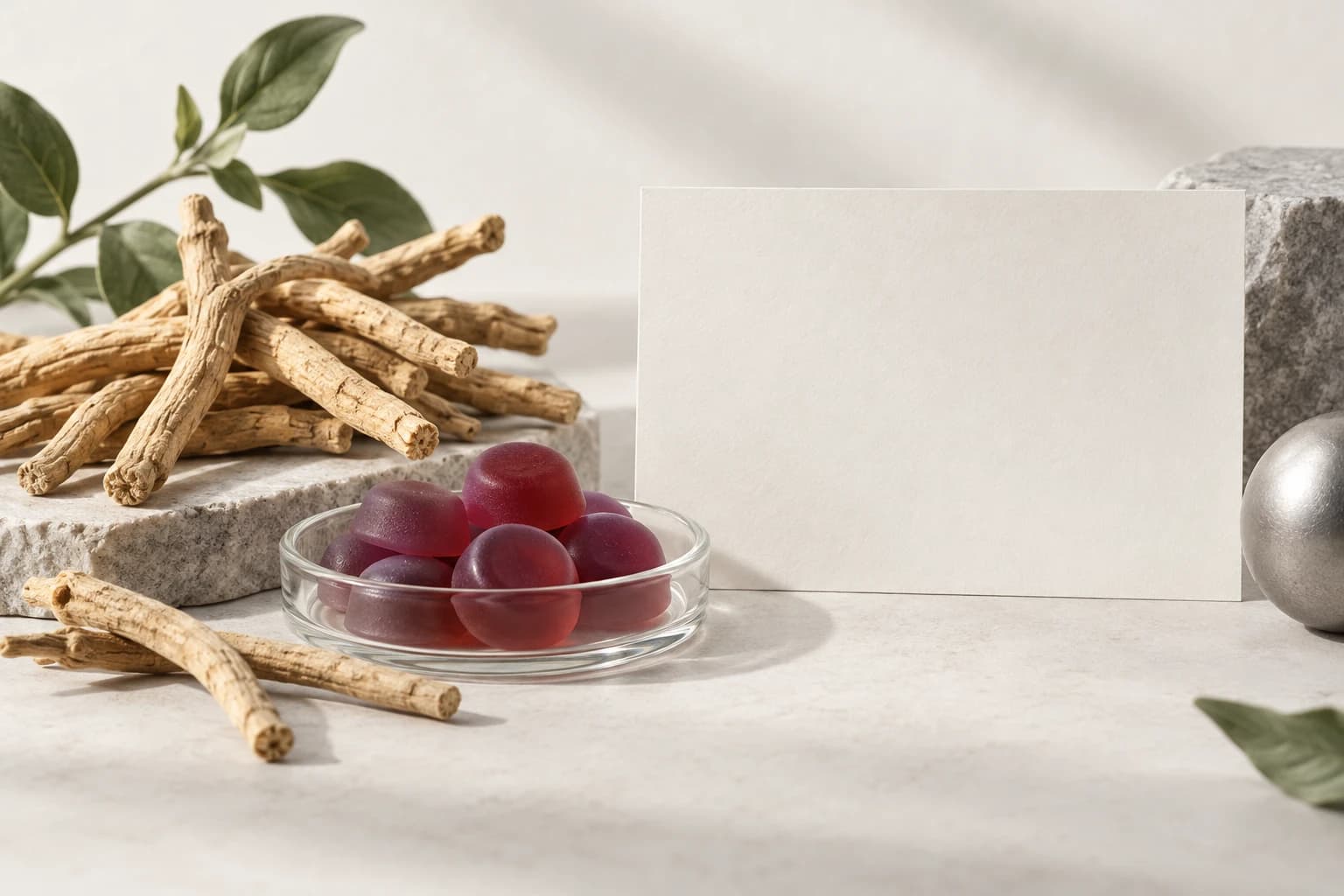
The useful question is how the extract specification translates into the gummy someone will take. That means connecting the ingredient's identity and analytical basis with the serving size, sensory result and finished-product evidence. The examples below explain the calculations; they are hypothetical specifications, not recommended doses or confirmed product formulas.
Root extract is a starting description, not a complete identity
Ashwagandha is Withania somnifera. A description such as “ashwagandha root extract” identifies the plant and plant part, but still leaves the extraction process and composition open. The NCCIH overview notes that supplements can contain root, leaf or root/leaf extracts and that studies have used varied preparations. These descriptions should remain distinct when comparing ingredients.
A root-only brief therefore needs a root-only specification. Substituting a root-and-leaf preparation changes the ingredient identity, even if both documents show the same extract weight or headline constituent percentage. Equally, an unbranded root extract should be described by its own specification rather than by the name or research credentials of a branded ingredient. Neither a botanical name nor a matching percentage establishes that two preparations are interchangeable.
The extraction solvent and the amount of carrier also belong in the comparison. They help describe what the ingredient is, rather than merely how prominently it can be presented on a pack.
Extract ratio and root equivalent describe the starting material
An extract ratio relates the amount of starting herb to the resulting extract. In a clearly defined 10:1 native extract, ten units of starting herb produce one unit of native extract. It does not mean ten times the clinical effect, ten times the withanolides or ten times the amount of finished gummy.
The EMA declaration guideline distinguishes the genuine, or native, preparation from added excipients, including carriers. It also identifies extraction solvent and native extract ratio as relevant descriptors. This is an EU herbal-medicine guideline; the terminology is useful for understanding extracts, not a global gummy-label rule.
That distinction changes the arithmetic. Suppose a supplied powder weighs 200 mg and contains 80% native extract plus 20% carrier. It contains 160 mg of native extract. If the declared 10:1 ratio applies to that native fraction, the corresponding starting-herb quantity is 1,600 mg: 200 × 0.80 × 10. Multiplying the entire supplied powder by ten would incorrectly count the carrier as extracted herb.
By contrast, 200 mg consisting entirely of native extract at the same ratio corresponds to 2,000 mg of starting herb. Both calculations depend on the stated ratio basis. Neither establishes the constituent content or proves equivalence to eating that amount of root powder. For a real proposal, the ingredient description must make clear whether “extract weight” includes carrier before a root-equivalent number can be interpreted.
A withanolide percentage needs a defined test
A constituent percentage answers a separate question: how much of a specified constituent or group was measured in the tested material? Withanolides and withanosides, the latter being withanolide glycosides, are among the compounds measured in ashwagandha. A heading such as “total withanolides” still needs a definition of which compounds are included in that total.
NIST's laboratory comparison report, in its withanolides chapter, examined individual compounds in ashwagandha root powder and extract. It found differences between laboratories and discussed sample extraction, calibration and reference materials as analytical considerations. Its samples were powders, not gummies; it does not validate a method for a particular finished gummy.
For a meaningful comparison, the specification and certificate of analysis should identify the analytes, method, units and reporting basis. A result reported on a dry basis excludes moisture from its denominator; a result for material as supplied uses a different denominator. Those figures cannot simply be attached to the same ingredient weight without accounting for the difference.
Likewise, “by HPLC” names an analytical technique, high-performance liquid chromatography, rather than a complete method. It doesn't by itself say which compounds were quantified or how the sample was prepared. This matters when two suppliers use the same word, “total,” for different sums. Compare like with like before treating a higher percentage as a higher specification.
Compare the serving on a common basis
The calculation is straightforward once the basis is fixed: extract weight per serving × constituent percentage ÷ 100 gives the calculated constituent amount per serving. The percentage must apply to the same material whose weight is used.
| Specification | Example A | Example B |
|---|---|---|
| Extract / serving | 200 mg | 100 mg |
| Withanolides (%) | 5% | 10% |
| Withanolides / serving | 10 mg | 10 mg |
| Gummies / serving | 2 | 2 |
| Extract / gummy | 100 mg | 50 mg |
| Withanolides / gummy | 5 mg | 5 mg |
These examples assume the same analytes and comparable methods, with both percentages applying to the complete supplied extract. They show why twice the extract weight can produce the same calculated marker amount. They do not show equivalent composition, absorption, safety or clinical benefit, and the calculated numbers are not finished-gummy assay results.
Serving size also changes the pack's meaning. A 60-gummy pouch with two gummies per serving contains 30 servings. If the directions specify one serving daily, that corresponds to 30 days. Without those directions, “30 servings” and “a month's supply” are different statements. The pack count alone doesn't establish daily use.
The same extract target can create different gummy projects
The amount of supplied powder matters to formulation even when the calculated marker amount is identical. In the examples above, A places twice as much extract powder into each gummy as B. If both gummies weigh 2 g, their supplied-extract loadings are 5% and 2.5% by weight respectively. Those are simple mass calculations, not predictions of which gummy will taste or perform better.
A more concentrated ingredient could reduce the powder required for a selected marker target. That can be a useful formulation option, but it doesn't establish the ingredient's flavor, dispersion or suitability in the selected base. The comparison still needs the actual extracts in the proposed formula. A plain berry gummy cannot demonstrate how either extract will taste after incorporation.
Sensory review is most informative when it keeps the serving and formula version visible. Aroma, sweetness, acidity, aftertaste, chew and appearance describe different aspects of the result. A flavor adjustment can improve the overall preference while leaving an unwanted aftertaste unresolved. If the extract, base or serving changes between samples, the result belongs to the new combination; it isn't evidence that the flavor change alone caused the improvement.
Pectin identifies a gelling ingredient, not the whole recipe. Carrier, sweetener, flavor and coating still form part of the finished product. A pectin specification alone cannot establish a vegan or gluten-free claim. The broader gummy development guide covers format decisions; this extract comparison should remain attached to the particular formula used in sample evaluation.
An ingredient result is not a finished-gummy result
A certificate of analysis for the incoming extract describes the tested ingredient batch. It doesn't directly measure the amount present in a finished gummy, its distribution across units or its condition after storage. Similarly, the calculated amount added to a batch is a formulation input, not a laboratory measurement of the output.
The analytical question changes with the sample. A method used for powder needs evidence that it can recover and measure its intended compounds in the gummy matrix. NIST's discussion of sample preparation explains why the extraction step matters; it should not be read as a ready-made gummy test protocol. Differences between a calculated input and a measured result warrant investigation of both manufacturing and analytical factors, rather than an automatic assumption that the extract has degraded.
Time is another boundary. A result at manufacture cannot, on its own, establish the same result at the end of storage. A useful shelf-life assessment relates the actual formula, packaging and proposed storage conditions to the attributes being assessed. An attractive fresh sample, a resealable pouch and an ingredient assay each answer different questions.
Research and product presentation have different limits
Matching a study's ingredient name or constituent percentage doesn't reproduce its preparation, serving or participant group. The NCCIH review describes small studies using varied preparations and uncertainty about long-term safety. Evidence for a preparation should therefore be evaluated against the proposed product and audience before it supports product wording.
NCCIH advises avoiding ashwagandha during pregnancy and breastfeeding, highlights medication interactions, and reports rare liver-injury cases. An adult-oriented gummy presentation is not proof of suitability for every adult. These considerations belong in qualified safety and label review for the intended market; a pleasant flavor or evening-use setting cannot establish safety or a sleep benefit.
The Ashwagandha Gummies product page describes a root-extract direction with mixed berry flavor, a pectin base and 60 gummies per resealable pouch, with two gummies per serving. It does not establish either hypothetical extract specification used above. Those examples explain how to compare a proposal, rather than filling an unconfirmed product specification.
Once the extract basis and desired serving are understood, the OEM / ODM process provides context for developing the formula and sample together. A gummy project discussion can then focus on the tradeoffs that matter for that combination, rather than selecting an extract by its largest headline number.