Product Development
Supplement Sampling Process: A Practical Buyer Guide
Sampling Process Guide · 11 min read · Published 2026-09-04 · Updated 2026-10-02
Use supplement samples to review taste, texture, appearance and serving size. Record feedback, request changes and approve a version before discussing production.
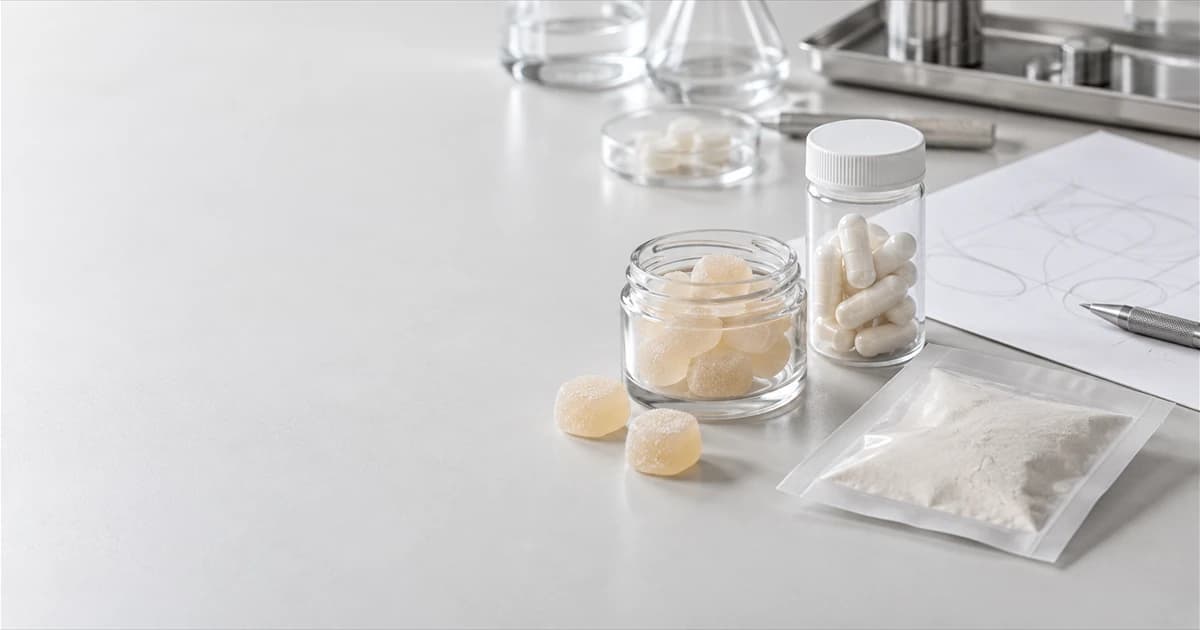
Decide what you want to learn from the sample before reviewing it. For example, check whether the taste, texture, appearance and serving size match your brief. Separate approved features from requested changes and questions that need further testing.
For the wider project sequence, see the OEM / ODM process. prepare a supplement OEM / ODM project
What a supplement sample is designed to do
A sample is most useful when it tests a defined hypothesis in the brief. For example, a team may need to see whether a proposed gummy direction has the intended chew and flavor profile, whether a powder mixes in the intended way, or whether a capsule size fits the intended use experience. The sample is then a shared reference for discussing those questions.
That framing prevents two common mistakes. The first is treating a sample as a broad yes-or-no judgment on an unfinished concept. The second is treating a positive sensory reaction as proof that every later manufacturing, packaging or market question is closed. A thoughtful review keeps the claim narrow: this version helps the team decide whether the current direction should continue, change or be documented for the next review.
The definition of “good” should come from the brief. If taste, texture, appearance, portion size or mixing experience matters, name it before the review. If a feature is not yet decided, label it as open rather than allowing reviewers to assume it was intentionally approved.
Before sampling, separate fixed inputs from flexible inputs
Before a sample is prepared, create a short decision sheet. It need not contain every future production detail. It should capture the inputs that make the review meaningful and distinguish them from preferences that may move.
Fixed inputs
Fixed inputs are requirements that the current sample should respect. Depending on the project, they may include the intended dosage form, a defined serving direction, ingredient or formula constraints supplied by the buyer, a target market context, or an approved packaging constraint. “Fixed” does not mean universally final. It means the team has chosen not to test alternatives for that review round.
Flexible inputs
Flexible inputs are areas where the project is still exploring trade-offs. These may include flavor direction, texture preference, appearance, serving presentation or an open packaging choice. A flexible input is not a vague one. Write down the permitted range or the decision the team wants the sample to inform.
Open questions
Open questions should remain visible. They might concern the next formula discussion, a pack component, product labeling, a commercial assumption or an applicable market review. Hiding an open question inside a positive sample review creates rework later. A simple “open / owner / next decision” column is usually more useful than a long meeting note.
| Review field | What to record | What not to infer |
|---|---|---|
| Dosage form | The format being reviewed and its intended use context | That all production settings are confirmed |
| Formula direction | The current ingredients or constraints supplied for review | A health, efficacy or market claim |
| Sensory target | The characteristics reviewers should assess | Universal consumer acceptance |
| Packaging direction | Any dimension, count or handling constraint relevant to the sample | Final pack availability, MOQ or price |
| Market context | The market question that needs separate review | Compliance approval |
Step 1: Agree What to Review in the Sample
By the end of this step, every reviewer should be able to explain why the sample exists. Start with one to three decision questions, not a wish list. For a chewable format, the question might be whether the current sensory direction is acceptable for the intended concept. For a powder, it might be whether the proposed serving presentation supports the intended use occasion.
Write each question in a form that can be answered after review: continue, adjust or hold for another decision. Avoid questions that promise an outcome the sample cannot establish, such as “Is the product market-ready?” or “Can production start now?” Those are broader decisions with their own evidence and owners.
Make the evaluation criteria visible before anyone sees the sample. If reviewers disagree, the resulting feedback can be sorted by criterion rather than by preference alone. This does not make sensory judgment objective, but it makes the decision trail clearer.
Step 2: Record the Sample Version and Formula
By the end of this step, the team has a version record that connects the physical sample to the brief. Give the sample a clear identifier and record the date, the input set being reviewed, the questions it was intended to answer and any conditions necessary to interpret it.
The point is traceability of decisions, not an appearance of formal certification. When a later conversation refers to “the version everyone liked,” the record should show which version that was and what “liked” meant. A version record also makes it easier to separate a change in flavor direction from a change that may affect the wider product route.
Do not fill gaps with assumptions. If the team does not know whether an element is final, mark it open. If a reviewer wants a change, describe the requested outcome and the reason rather than declaring a technical solution that has not been assessed.
Step 3: Review Taste, Texture and Appearance
By the end of this step, the team has observations connected to the agreed criteria. The right review depends on the dosage form. A gummy may prompt questions about chew, flavor release and appearance. A capsule may prompt questions about swallowing experience and the relationship between the proposed fill and intended serving direction. A powder may prompt questions about aroma, taste, texture and mix experience in the chosen preparation context.
Reviewers should describe what they observed before proposing a fix. “The finish remains too sweet for the intended profile” is more useful than “change the formula” because it identifies the problem without assuming the answer. Where relevant, compare the observation with the target stated in the brief.
The same discipline applies to visual and handling impressions. A sample may help a buyer notice that a portion feels large for the intended pack, or that a proposed appearance does not fit the concept. That observation can trigger a further project decision. It cannot confirm that a final pack component will be available or that commercial conditions are settled.
Step 4: Review Packaging and Labels Separately
By the end of this step, the team has separated product-experience feedback from questions that need another review. Packaging can affect how a sample is handled, presented or judged, so it belongs in the discussion when it creates a constraint. But a sample does not establish final packaging supply, price, minimum order quantity or delivery timing.
Likewise, a good sample review is not a substitute for a label or market review. For U.S.-market projects, FDA guidance describes several required label statements for dietary supplements, including identity, net quantity, nutrition labeling, an ingredient list and business information for the manufacturer, packer or distributor (FDA labeling guide, retrieved 2026-09-30). Requirements vary by market and product context. This is a general process point, not legal advice or a statement that any particular product meets a requirement.
The same boundary applies to product claims. FDA explains that dietary-supplement labeling claims have distinct categories and requirements, and that claims must be truthful and not misleading (FDA label-claims guidance, retrieved 2026-09-30). A favorable sample reaction does not validate an external health, efficacy or regulatory claim. Keep those questions with the appropriate qualified review for the intended market.
Step 5: Record Approvals and Requested Changes
By the end of this step, feedback is sorted into approved items, requested changes and unresolved questions. Capture observations while the review context is still clear. Then assign each item to one of three paths:
- Approved for the current brief. State exactly what is approved and for which version.
- Change requested. State the intended outcome, the reason and the person or team responsible for assessing it.
- Open for separate review. State what additional information, approval or market-specific input is needed.
This sorting matters because not every comment carries the same consequence. A preference about flavor direction may call for another development discussion. A question about a package component may need commercial confirmation. A proposed external statement may need regulatory or legal review. The sample review should make those handoffs visible rather than collapsing them into a single “approved” status.
Use precise language in the change log. “Make it better” is not a decision. “Assess whether a less sweet finish can meet the stated sensory target without changing the intended format” gives the next reviewer something specific to evaluate. The assessment may still show that a trade-off is required. That is useful information, not a failed sample.
Step 6: Confirm the Approved Sample Before Production
By the end of this step, the project has a clean handoff from the sample review to the next decision. Closing the record does not mean every production input has been finalized. It means the team can identify what the sample established, what changed and what must still be confirmed elsewhere.
Before moving forward, check that the record includes the reviewed version, the approved characteristics, requested changes, packaging or commercial dependencies and any outstanding market or documentation question. If a change occurs after the review, assess it against the same list. A change to formula direction, format, pack or intended claim may affect more than one part of the route.
Before production, confirm equipment settings, ingredient availability, packaging components and the finished-product specification. Record any changes made after sample approval.
Common sampling mistakes to avoid
Reviewing without a stated question. A sample becomes a preference poll when no one has agreed what it must help decide. Start with a short set of review questions and evaluate observations against them.
Calling all feedback “approval.” An enthusiastic response may still contain requests, dependencies or unanswered questions. Separate each status in the record.
Using the sample to settle commercial variables. A physical reference can reveal a packaging concern, but it cannot set MOQ, price, production timing or component availability. Put those items on the relevant commercial track.
Turning a sensory observation into a product claim. Liking a flavor or texture does not substantiate an external efficacy, health or market-compliance statement. Keep claims and label review separate.
Losing the version history. If the team cannot connect a decision to a version and a stated criterion, later changes become difficult to interpret. Give every reviewable sample a simple record.
What a successful sampling review looks like
A successful review leaves the team with a clear next decision, not necessarily a final commercial product. The team can name the version reviewed, the intended criteria, the approved elements, the requested changes and the open dependencies. It can also explain which questions were intentionally not answered by the sample.
That result is useful whether the next step is another development review, a packaging discussion, a market-specific assessment or a broader manufacturing conversation. The goal is decision clarity: an early physical reference should reduce ambiguity, not hide it.
Example: a Powder Sample Feedback Record
This fictional example shows how to describe an observation and request a revision. It is not a test result or customer case.
| Field | Example record |
|---|---|
| Sample identification | Sample A, formula revision 01, received date recorded by the buyer. |
| Preparation | Use the same sample weight, water volume, water temperature and mixing method for both versions. |
| Observation | Buyer finds the sweetness stronger than the agreed reference. |
| Requested change | Ask for a less sweet version; retain the flavor direction for comparison. |
| Other observations | Record mouthfeel and visible dispersion separately from the sweetness comment. |
| Decision | Revision requested; the sample is not yet approved for production. |
| Approval owner | Named buyer contact consolidates feedback and signs off the accepted version. |
Add laboratory results in a separate record with the sample identity, method and acceptance limit. A tasting observation cannot replace testing. For format-specific inputs, review powder manufacturing, softgel manufacturing or liquid supplement manufacturing.
Frequently asked questions
Does a supplement sample confirm the final production product?
No. A sample can support a review of the current brief and the intended product experience. Production settings, material availability, pack components, finished specifications and other scale-up inputs need their own confirmation.
How many sample revisions should a project expect?
The number depends on the formula, format and requested changes. Discuss the sampling plan and any revision costs with the manufacturer before development begins.
Does a sample determine MOQ or lead time?
No. Samples help review the product. Minimum order and delivery timing depend on the formula, packaging, quantity and production schedule.
Can a sample approve label claims or regulatory compliance?
No. A sample review should not be used to approve product claims or market compliance. Those topics require the appropriate review for the intended product and market.
What should a buyer send before a sampling discussion?
Bring the intended dosage form, formula or ingredient direction, sensory targets where relevant, packaging constraints, target market context and the specific questions the team needs the sample to help resolve. project brief requirements
Record Sample Feedback and the Next Steps
The best use of a supplement sample is simple: make the next decision clearer. Define the question, preserve the version record, review against stated criteria and keep commercial or market questions visible until they receive the right review. For the wider project path and a direct inquiry route, visit VITHELO’s OEM / ODM process or contact VITHELO.