Dosage Formats
Gummies vs Hard Capsules for Private-Label Projects
Dosage Form Comparison · 10 min read · Published 2026-09-04 · Updated 2026-10-01
Compare chewable gummies and swallowed hard capsules by taste, texture, ingredient compatibility, serving size, shell material and packaging.
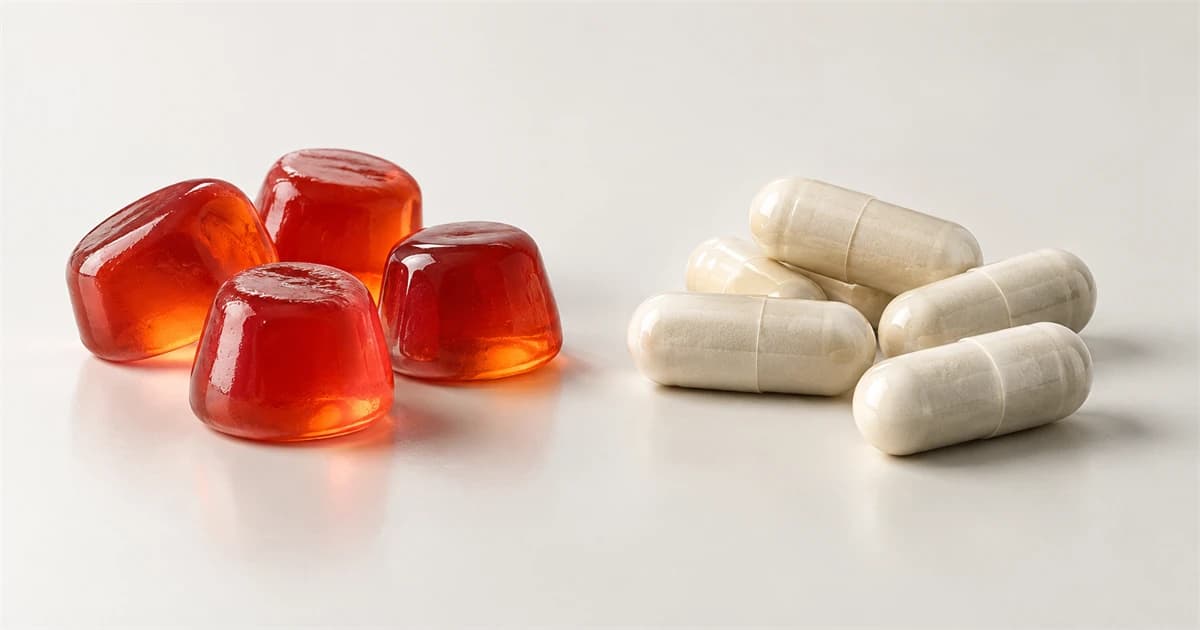
Use this comparison when choosing between a chewable product and a swallowed capsule. Review the ingredients, serving size and pack for each option with the manufacturer.
Chewable Gummies or Swallowed Capsules?
Choose gummies if the product must be chewed and its flavor and texture are part of what the buyer wants the end user to notice. Choose hard capsules if the intended routine is to swallow a measured serving and a neutral sensory route is more appropriate. That is a starting rule, not a manufacturing guarantee.
The format should be described before a formula is presented as settled. For gummies, that description includes the desired sensory result, serving count, shape or appearance where relevant, and the type of pack under consideration. For hard capsules, it includes the desired capsule shell, fill type, capsule size, serving count and any material constraints. The same ingredient concept can raise different questions in each route.
For a broader shortlist across formats, use the supplement-format decision guide. Once gummies and hard capsules are the remaining candidates, the comparison below is more useful than a generic list of format benefits.
Gummies and hard capsules: a buyer's decision table
| Decision variable | Gummies | Hard capsules | What to put in the brief |
|---|---|---|---|
| Use experience | Chewed. Flavor, sweetness and texture are experienced directly. | Swallowed. The shell separates the user from much of the fill's immediate taste. | State chew or swallow, the intended routine and non-negotiable sensory expectations. |
| Serving design | Piece size and number of pieces belong to the proposition. | Capsule size and number of capsules belong to the proposition. | State the intended serving, not only the ingredient list. |
| Formula fit | The active concept must be assessed with the gel system and sensory target. | The fill must be assessed with powder properties, shell choice and capsule volume. | Supply ingredient form, target amount and known incompatibilities. |
| Differentiation | Shape, color, flavor and texture may be visible parts of differentiation. | Shell material, capsule appearance and pack presentation can support the concept. | Identify which product cues are essential and which are optional. |
| Packaging | Pack selection must protect the finished product while fitting count and use. | Pack selection must fit capsule count, shell and fill considerations. | Name preferred pack, market, labeling assumptions and transport context. |
| Review work | Sensory targets need defined acceptance criteria. | Fill and shell choices need defined acceptance criteria. | Ask for a documented development and specification review, not a format promise. |
For cost, minimum order and timing, ask for separate quotations using the same ingredient requirements and order quantity. The gummy formula, capsule shell, packaging and production steps can change the result.
When a gummy route is the better starting point
A gummy route is a stronger starting point when the product's chewable experience is central to the brief. This can be the case when a buyer wants the serving to feel food-like, when flavor direction is a meaningful brand cue, or when the sensory experience should be described as part of the product concept. The conclusion is conditional: the formula still needs to work with the chosen gel system, piece size and intended serving.
Gummies are not simply capsules with a different exterior. A 2026 review, Perspective on Gummy Dietary Supplements Manufacturing and Testing, identifies formulation, manufacturing and analytical testing challenges in gummy dietary supplements. That does not establish a problem with a particular proposed product. It does establish why a buyer should bring flavor, texture, piece count and stability questions into the first technical conversation rather than postponing them until packaging artwork is complete.
Use a gummy-first brief when these statements are true:
- The user experience must be chewable, and taste or texture is part of the proposition rather than an afterthought.
- The buyer can describe acceptable sensory trade-offs, such as the intended flavor profile and texture direction, without making an unverified health claim.
- The intended serving can be discussed as pieces and a total serving, rather than as an ingredient list alone.
- Packaging is open for review with the product, rather than fixed before the product characteristics are known.
The useful decision is not "do we want gummies?" It is "are we willing to own the sensory brief?" A gummy concept without sensory acceptance criteria leaves a core part of the product undefined. If these sensory criteria are undefined, complete the use-experience brief before choosing either route.
Read the gummy development guide for more detail on flavor, texture, piece size and packaging.
When hard capsules are the better starting point
Hard capsules are a stronger starting point when a swallowed serving suits the intended routine and the project does not rely on a flavored chewable experience. They may allow the brief to focus on the fill, shell material, capsule size, capsule count and pack instead of on a direct sensory proposition. This is not a claim that capsule development has fewer constraints. It is a different constraint set.
Hard capsule filling makes the physical behavior of the fill relevant to the route. The review Rational design of powder formulations for tamp filling processes describes tamp filling as a commonly used process in which powder is formed into a loosely packed plug before it is dispensed into a hard gelatin capsule. In a private-label brief, the practical implication is modest but important: supply the ingredient form and serving target early, then ask the development team to assess the fill and capsule system. Do not infer a fill weight, capsule size or manufacturing outcome from a product photo.
The word "capsule" also does not settle the shell question. Gelatin and Non-Gelatin Capsule Dosage Forms describes hard and soft capsule shells made with gelatin or non-gelatin polymeric materials, including hypromellose and starch. A buyer with a shell-material requirement should state it in the brief and request a route-specific review. This article does not decide suitability for dietary, cultural, allergen, regulatory or market requirements.
Use a hard-capsule-first brief when these statements are true:
- A swallowed serving fits the desired user routine.
- The concept does not depend on flavor, chew or texture as a primary brand signal.
- The buyer can provide the ingredient form, proposed serving and shell-material requirements for review.
- The pack can be evaluated with the capsule count and the specific product system, rather than chosen in isolation.
Explore the hard capsule format page for format-specific questions.
Do not transfer the same brief unchanged between formats
The main development risk is treating the same ingredient list as if it will behave identically in both formats. A gummy asks how the formula direction interacts with the gel system, sensory result, serving count and packaging. A hard capsule asks how the fill interacts with the selected shell, capsule size, count and packaging. Neither set of questions can be answered by visual preference alone.
For products intended for the United States, format work also belongs inside a documented quality and labeling system. The FDA's Small Entity Compliance Guide explains that dietary-supplement specifications cover components, in-process production, labels and packaging, finished batches, and certain received products. It also states that tests or examinations used to determine whether specifications are met must be appropriate and scientifically valid. Check the applicable requirements for the destination market.
That distinction matters to a private-label buyer. A product brief should name its destination market, but the article should not offer a legal conclusion. The NIH Office of Dietary Supplements brochure notes that U.S. supplement companies are responsible for evidence of safety and for truthful, non-misleading label claims. Confirm the applicable requirements and claims pathway with appropriately qualified parties for the intended market.
A practical brief for the comparison meeting
The best next step is a short comparison brief, not a request for a format to be declared "best." Bring the same fields for both options so the choice can be made on comparable information.
- Product use: Is the intended action chew or swallow? At what point in the user's routine is the serving used?
- Ingredient direction: What is the ingredient form, intended serving and any known handling or sensory concern? Do not convert an intended amount into a market claim.
- Experience priorities: Which features are non-negotiable: flavor, texture, shell material, capsule count, piece count, appearance or convenience?
- Packaging direction: What pack is preferred, and which parts remain open to change after technical review?
- Market and label context: Where is the product intended to be sold, and what claims or label text are proposed for independent review?
- Evidence plan: What specifications, samples, testing or documents will be required before a production decision?
This list complements the OEM / ODM project-preparation checklist. It does not replace a manufacturer review, a market-specific compliance review or a product-specific specification process.
Who should choose what?
Brand teams building around an edible experience: Start with gummies if the brand idea depends on chew, flavor or texture. Give the development conversation enough detail to evaluate those features together with the formula direction.
Teams prioritizing a swallowed routine: Start with hard capsules if the product is meant to be taken as a measured swallowed serving and the concept does not need a flavor-led experience. Define shell and fill questions before treating the capsule appearance as final.
Teams with a fixed formula but an undefined user experience: Pause the format selection. The missing input is not a supplier quote; it is a decision about how the product should be used and what trade-offs are acceptable.
Teams with a fixed package but no technical review: Keep the package provisional. Packaging, label and finished-product requirements must be evaluated against the actual route, as the FDA's U.S. CGMP guidance makes clear for applicable projects.
To move from a comparison to a complete project conversation, review the gummy format overview and the OEM / ODM project path, then prepare the inputs above.
Frequently asked questions
Are gummies better than hard capsules?
Neither format is better in general. Gummies fit briefs where chew, flavor and texture are central. Hard capsules fit briefs where a swallowed serving and fill-plus-shell assessment better match the concept. The product's ingredient form, serving, market and packaging assumptions still need route-specific review.
Can the same formula be used in gummies and hard capsules?
Sometimes, with formula changes. Gummies and hard capsules have different requirements for ingredients, serving size and taste. We check each format separately before confirming the formula and sample specifications.
Do hard capsules avoid all taste concerns?
No. A capsule shell can reduce direct taste exposure compared with a chewed format, but fill behavior, odor and the overall user experience can still matter. The brief should say whether neutral sensory presentation is a requirement rather than assuming it.
Is one option faster, cheaper or available at a lower MOQ?
Neither format is always faster or cheaper, or has a lower minimum order. Compare quotations for your formula, capsule shell or gummy base, packaging and quantity; these determine the costs and schedule.
Does this comparison confirm regulatory compliance?
No. The regulatory information here is limited to general U.S. source material and does not determine the rules for a particular product or market. Obtain qualified, market-specific review before using label claims or making a production decision.
Prepare Your Gummy or Capsule Enquiry
| Category | Better starting point |
|---|---|
| Chewable, flavor-led product experience | Gummies, if sensory targets can be defined |
| Swallowed, measured-serving routine | Hard capsules, if fill and shell can be assessed |
| Undefined consumer experience | Neither. Define the use case first |
| Fixed commercial terms without technical inputs | Neither. Validate the project system first |
| Overall | Conditional. Select the route that the brief can describe and validate |
Choose gummies when chew, flavor and texture are central to your product. Choose hard capsules when a swallowed serving fits the customer’s routine. Share your ingredients, serving size, packaging and target market when you start a project discussion.